
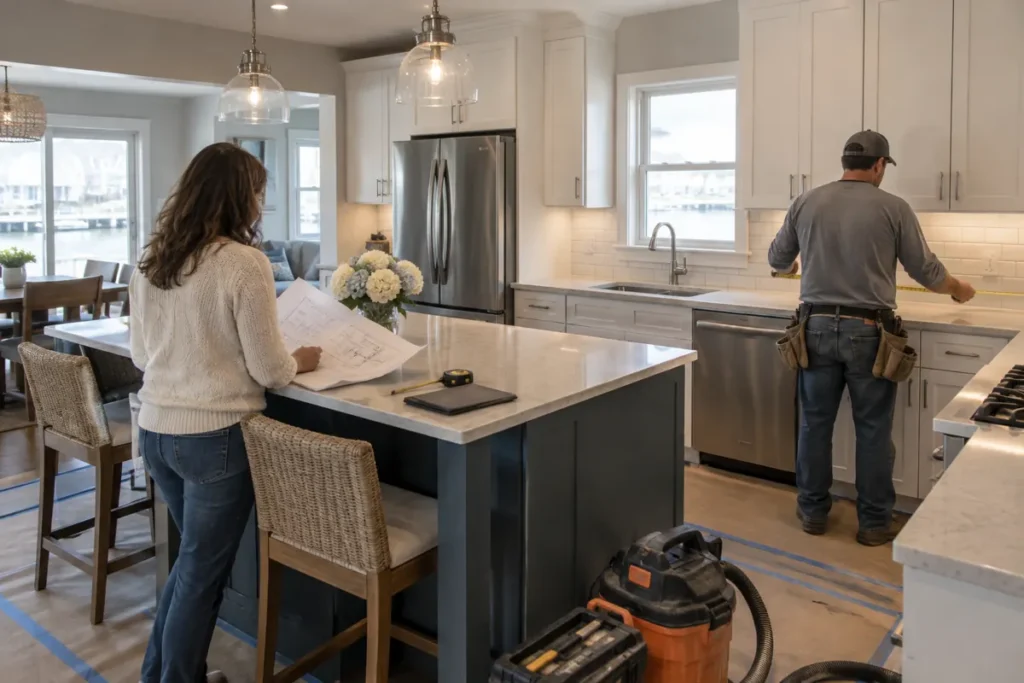
Quick answer: Remodel financing starts with a detailed project scope, a realistic contingency reserve and a monthly payment that leaves room for emergencies. New Jersey owners should compare cash, home equity, personal loans and eligible assistance programs by total borrowing cost, risk and timing, then judge ROI using both resale value and everyday usefulness.
Key takeaways
- Build the budget from a written scope, allowances, permits and a 10% to 20% contingency reserve.
- Compare financing by APR, fees, repayment term, collateral risk and funding speed, not monthly payment alone.
- Treat remodel ROI as added value divided by total project cost, while also considering durability and daily use.
- Coastal wind, salt air and storm exposure can justify durable materials even when they cost more initially.
- Do not sign a loan or construction contract until the scope, payment schedule and change-order process are clear.
What determines remodel costs in New Jersey?
Remodel costs are driven less by a single price-per-square-foot figure than by the exact work required. Two rooms of the same size can have very different budgets if one needs structural changes, electrical service upgrades, plumbing relocation or extensive repair behind finished surfaces.
The largest cost drivers are usually scope, material grade, labor complexity, site access and existing conditions. Custom cabinetry, specialty glass, large-format tile and nonstandard windows may also require longer lead times or specialized installation. Changing a layout generally costs more than replacing finishes in their existing locations because more trades and inspections become involved.
Permits, design work and code compliance also belong in the budget. The New Jersey Department of Community Affairs maintains the state’s adopted construction codes, but permit requirements and fees are administered locally. Before committing funds, confirm the applicable requirements with the municipal construction office for the property.
Coastal conditions deserve special attention in Ocean and Monmouth County. Wind-driven rain, salt air, seasonal storms and moisture can expose hidden sheathing damage, failed flashing or corroded components. A low initial estimate that ignores those risks may be less useful than a complete estimate that explains assumptions and allowances.
Keep each service scope specific rather than relying on a generic remodeling average. Homeowners comparing interior and exterior priorities can review Shoreline Home Solutions’ completed remodeling projects to see how project size and finish choices differ without treating another home as an exact pricing model.
How should you build a realistic project budget?
Begin with a written scope that separates needs from preferences. Safety repairs, water intrusion, structural concerns and code issues belong in the first category. Finish upgrades, layout changes and premium products can then be ranked by how much value they add to daily life.
Angi recommends reserving 10% to 20% of a remodeling budget for unforeseen expenses. The appropriate reserve depends on uncertainty: a newer, accessible room with minimal demolition may justify the lower end, while an older shore property with previous leaks or concealed framing may need the higher end.
- Define the outcome. Describe what must function better, not just what should look different.
- List the complete scope. Include demolition, disposal, repairs, labor, fixtures, finishes, permits and final cleanup.
- Set allowances. Assign realistic spending limits for items not yet selected, such as tile, hardware or lighting.
- Add owner-side expenses. Consider temporary storage, meals, pet arrangements or alternate accommodations when rooms will be unavailable.
- Add a contingency reserve. Keep it separate from upgrade money so a concealed repair does not automatically increase borrowing.
- Set a stop point. Decide which optional features will be removed first if bids exceed the target.
For multi-room work, build the budget in phases and identify dependencies. Replacing finishes before resolving leaks or exterior openings can create avoidable rework. The whole-home remodeling planning guide explains how broader scopes fit together.
Which remodel financing option fits your project?
The best remodel financing method depends on project size, available equity, credit profile, urgency and tolerance for risk. Cash avoids interest, but using too much can leave an owner without an adequate emergency reserve. Borrowing preserves cash but adds fees, interest and repayment obligations.
| Option | Usually fits | Main advantage | Main caution |
|---|---|---|---|
| Cash savings | Defined projects that do not drain emergency funds | No interest or loan approval | Reduces liquidity immediately |
| Home equity loan | Projects with a stable, known budget | Fixed lump sum and generally predictable payments | Home secures the debt; closing costs may apply |
| Home equity line of credit | Phased work or scopes with uncertain draw timing | Borrowers draw funds as needed | Rates may change, and the home secures the line |
| Unsecured personal loan | Smaller or time-sensitive projects without using home equity | Often faster and no property collateral | Rates can be higher than secured borrowing |
| Cash-out refinance | Large projects when replacing the existing mortgage makes financial sense | Combines borrowing into a new mortgage | Resets mortgage terms and may raise the rate on the entire balance |
| Credit card | Small purchases that can be repaid within a confirmed promotional period | Convenient purchasing and possible rewards | High ongoing interest and deferred-interest terms can be costly |
| Rehabilitation assistance | Eligible repairs for qualifying owner-occupants | May offer deferred financing for approved work | Income, property, location and scope rules apply |
Angi notes that home equity loans and lines of credit commonly offer lower rates than unsecured options, although the property is collateral. Ask each lender for the annual percentage rate, origination and appraisal fees, draw rules, prepayment terms, minimum payment and total repayment estimate.
Ocean County also publishes an owner-occupied Housing Rehabilitation Program for qualifying low- and moderate-income households. Eligible work can include weatherization, accessibility, code, structural and roof issues. Brick, Toms River, Jackson and Lakewood have separate programs, so verify the property’s municipality and current eligibility before making plans around assistance.

How do you compare home improvement loans fairly?
A low monthly payment does not necessarily mean low-cost financing. Extending the term can reduce the payment while increasing total interest. Compare loan offers using the same requested amount and, when possible, the same repayment period.
Use this loan comparison checklist
- APR: This combines the interest rate with certain lender fees and is more useful than the rate alone.
- Total of payments: This shows the estimated amount repaid if the loan follows its scheduled term.
- Upfront cash: Include closing costs, appraisal charges, points and required down payments.
- Rate structure: Confirm whether the rate is fixed, variable or promotional.
- Collateral: Understand whether missed payments could put the home at risk.
- Draw process: For a credit line, learn how funds are requested and when repayment begins.
- Prepayment rules: Check whether early payoff carries a penalty or fee.
- Contract timing: Do not borrow so early that interest accrues during a long design or product-selection period.
Request official disclosures directly from lenders and read them before signing. A licensed contractor can define construction scope, but questions about taxes, loan suitability or legal obligations belong with a qualified lender, financial professional, accountant or attorney.
Match the financing to the useful life of the improvement. Using long-term debt for short-lived cosmetic purchases can leave you paying after the materials need replacement. Conversely, paying cash for all work may be unwise if it eliminates the reserve needed for insurance deductibles, storm repairs or household emergencies.
What calculators help with project budgeting and loan decisions?
You do not need a complex spreadsheet to test affordability. Use three simple calculations, then compare the results with a detailed contractor estimate and formal lender disclosures.
1. Total project budget calculator
Base estimate + design and permit costs + owner purchases + temporary living costs + contingency reserve = total project budget. Avoid counting an allowance twice if it is already included in the base estimate.
2. Funding gap calculator
Total project budget − cash assigned to the project − confirmed grants or assistance = maximum financing need. Keep emergency savings separate rather than treating every available dollar as project cash.
3. Affordable payment test
Monthly take-home income − essential expenses − existing debt payments − regular savings − safety margin = maximum available remodel payment. This is a personal ceiling, not a lender’s approval amount. Test whether the payment still works after insurance, tax, utility or maintenance increases.
4. Bid normalization worksheet
Put each estimate into the same columns: scope, product specifications, allowances, exclusions, permits, payment schedule, expected duration and warranty information. A lower total is not comparable if major work is excluded or products are described only as “standard.”
Shoreline Home Solutions offers a free estimate following its consultation and estimate process. Owners in its 24-town Ocean and Monmouth County service area can contact the remodeling team to discuss a property-specific scope rather than relying on a generic online average.
How should you calculate remodel ROI in New Jersey?
Remodel ROI is commonly estimated with this formula: (estimated increase in property value ÷ total project cost) × 100. If a project costs more than the value it adds at resale, the financial ROI is below 100%. That does not automatically make it a poor decision because comfort, safety, accessibility and reduced maintenance also have value.
Online ROI percentages are broad benchmarks, not promises for a specific New Jersey property. Local sale prices, neighborhood expectations, workmanship, product choices and market timing all affect the result. Before a major investment, ask a local real estate professional or appraiser how buyers in the immediate market respond to the proposed improvement.
| Project objective | Value to measure | Potential mistake |
|---|---|---|
| Sell soon | Likely buyer appeal and appraised contribution | Choosing highly personal finishes that narrow the buyer pool |
| Stay long term | Daily function, comfort and reduced maintenance | Judging success only by immediate resale value |
| Address coastal exposure | Durability, water management and easier upkeep | Paying for appearance while leaving vulnerable assemblies unresolved |
| Add living space | Usable square footage, layout and local market demand | Ignoring zoning, structural work and carrying-cost changes |
| Improve efficiency | Comfort, air sealing and documented utility use | Assuming product labels alone guarantee savings |
At the Jersey Shore, resilience can support long-term value even when it is not fully captured by a resale calculator. Correct flashing, appropriate exterior materials and properly installed openings can help manage wind and moisture exposure. Our coastal remodeling guide covers those design considerations in greater depth.
How can you control overruns without cutting the wrong things?
Cost control begins before construction. Finalize major selections, verify product availability and make sure the contract identifies what is included. Unresolved allowances can be practical early in design, but too many allowances make the final total difficult to predict.
Do not automatically cut waterproofing, structural repair, flashing, electrical safety or required code work. Those items protect the building and its occupants. If a budget needs to shrink, first consider simplifying the layout, reducing custom details, selecting readily available finishes or phasing nondependent work.
Use a formal change-order process
Every change should describe the revised work, added or credited amount, schedule effect and required approval. Verbal requests are easy to misunderstand and difficult to reconcile later. Keep a running log showing the original contract, approved changes, payments and remaining contingency.
Large additions and structural alterations require especially careful early planning. Review the home additions guide before treating expanded living space as comparable to a finish-only renovation.
Stop work and contact a licensed professional when demolition reveals structural movement, unsafe wiring, active leakage, suspected hazardous material or conditions outside the agreed scope. Shoreline Home Solutions is a licensed and insured remodeling contractor based in Bayville, serving listed communities across Ocean and Monmouth County. Its process includes consultation and estimate, design and planning, construction and a final walkthrough; homeowners can verify whether their town appears on the full service-area list.
What should you verify before signing the contract and financing?
Read the construction contract and loan documents as separate obligations. The contractor’s payment schedule may not match the lender’s draw schedule, so confirm how deposits, material orders, inspections and final payment will be funded before work begins.
- Scope: Confirm the rooms, systems, demolition, repairs, finishes and cleanup included.
- Specifications: Record manufacturers, product lines, colors or measurable allowances where selections remain open.
- Exclusions: Identify owner purchases, painting, moving, utility work or repair items that are not included.
- Permits: State who applies, who pays and how inspection-related changes are handled.
- Payment schedule: Tie payments to clear contract terms or progress points rather than assumptions.
- Changes: Require written approval for scope, price and schedule adjustments.
- Credentials: Verify the contractor’s New Jersey home improvement contractor registration, any trade licenses required for the work and current insurance coverage.
- Financing: Confirm APR, fees, term, collateral, payment start date and total repayment.
- Final review: Document incomplete or corrective items before final acceptance.
New Jersey code requirements can change, and a project may fall under different provisions depending on whether it is repair, alteration, addition or new work. Consult the municipal code office and the New Jersey Department of Community Affairs for current requirements rather than relying on an old checklist.
Allow time to review everything without pressure. A clear scope and a financing plan should agree on the same project total, contingency and payment timing. If either document is unclear, resolve the discrepancy before signing or authorizing demolition.
Frequently Asked Questions
Can I combine cash and a home improvement loan for one remodel?
Yes. Many owners use cash for the deposit, design work or a portion of construction and finance the remaining gap. Keep an emergency reserve outside the project, and confirm that the lender’s draw timing matches the contractor’s payment schedule. Track both sources in one budget so you do not accidentally commit the same cash twice.
Should I get financing approval before requesting contractor estimates?
A preliminary lender conversation can reveal an affordable range, but a contractor estimate is usually needed to determine the actual borrowing requirement. The most practical sequence is to set a personal payment ceiling, obtain a defined project estimate, then compare formal loan offers. Avoid final borrowing until the scope, contingency and likely start timing are reasonably clear.
Does a remodel increase property taxes in New Jersey?
It can, depending on the type of work and whether the municipality determines that the improvement changes assessed value. Routine maintenance and substantial new improvements may be treated differently. Ask the local tax assessor about the proposed scope before assuming there will be no effect, especially for additions, major layout changes or newly finished living area.
Can remodeling costs change after a fixed-price contract is signed?
They can change if the owner approves added work, concealed conditions require work outside the original scope, or the contract contains allowances that reconcile to actual selections. A fixed price should still define assumptions and exclusions. Require a written change order showing the cost and schedule effect before authorizing work beyond the signed scope.
Is it better to renovate before selling or offer a buyer credit?
It depends on the property’s condition, buyer expectations and local market. Repairing obvious safety, water or maintenance problems may remove negotiation obstacles, while highly personal upgrades may not recover their cost. Ask a local real estate professional to compare likely sale outcomes, then weigh that advice against carrying costs, project timing and the risk of over-improving.
Sources
- New Jersey Department of Community Affairs — Current Construction Codes
- Ocean County Planning Board — Owner-Occupied Housing Rehabilitation
- Angi — How to Finance Home Renovations: 7 Options
- Angi — Home Remodel Cost Estimator
Ready to Start Your Remodeling Project
Shoreline Home Solutions is a licensed and insured remodeling contractor serving homeowners and businesses across Ocean and Monmouth County, New Jersey. Call us at 860-481-2908 or visit our contact page to request a free estimate for your kitchen, bathroom, exterior, or whole-home remodel.
Written by the team at Shoreline Home Solutions, a licensed and insured home remodeling contractor serving Ocean and Monmouth County, New Jersey.